
The call-outs we get for noise almost never involve the indoor unit. They involve a box on the outside of a house, fitted by somebody else, and a bedroom on the other side of the wall. The unit itself is fine. What is wrong is what it is bolted to, and how.
Two sounds, one of which you can hear through a wall
An outdoor unit makes two different kinds of noise. The fan makes the airborne kind, a steady rush of air rated by the manufacturers at around 46 to 50 dB(A) a metre away, about the level of a quiet conversation. Through a closed double-glazed window ten metres off, that fades to almost nothing. It is the sound people worry about in advance, and it is rarely the problem.
The compressor makes the other kind. It is a motor turning a pump, and it vibrates at a low frequency, a few tens of cycles a second. Low-frequency vibration does not care about windows. If the unit is fixed rigidly to a wall, the vibration goes straight into the brickwork, the wall carries it like a drum skin, and in the room behind it you hear a hum. Not loud, but constant, and at night constant is what counts.
So the question on a survey is never "how loud is this unit". It is "what is it going to be touching".
What rubber does
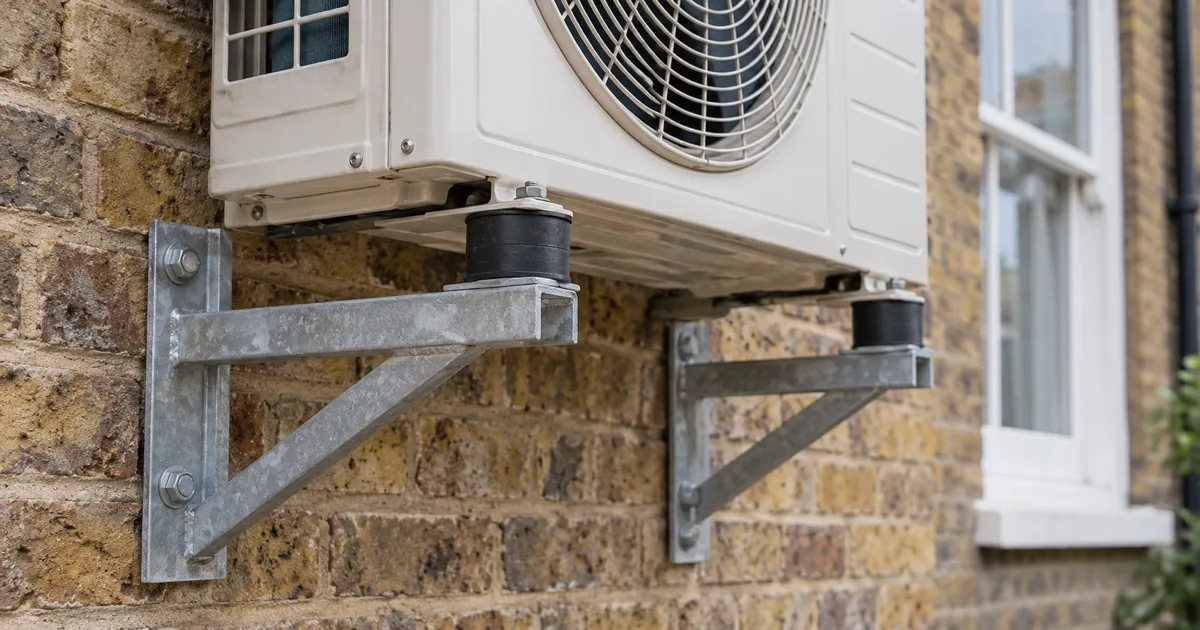
The fix is older than air conditioning: put something soft between the thing that vibrates and the thing that carries sound. Anti-vibration mounts are rubber or neoprene blocks, sometimes with a steel spring inside for the heavier units, that sit between the unit's feet and its bracket or stand. The vibration has to cross the rubber to reach the wall, and most of it does not make it.
On every installation we do, the unit sits on these mounts. On a wall bracket they go between the unit's feet and the bracket arms, and the bracket itself has rubber pads where it meets the wall. The whole thing costs a fraction of the unit and takes a few minutes, which is why it still surprises us how often we find a unit screwed hard to a bracket screwed hard to a bedroom wall.
The flat roof trap
A flat roof is often the best place for an outdoor unit in a London terrace, behind a parapet where nobody sees or hears it. It is also where we see the worst vibration mistakes.
The unit must not sit on the roof covering. A roof deck is a large, thin, flexible surface, and a unit stood directly on it, or on a plank, or on a couple of paving slabs, turns the whole roof into a sounding board, with the bedroom ceiling directly below. We use dedicated roof supports: a frame that spreads the load, stands clear of the membrane so water runs underneath, and carries the unit on rubber feet. The vibration stops at the rubber, the membrane stays undamaged, and the parapet takes care of the fan noise.
Where the front faces
The fan throws its air, and most of its sound, out of the front of the unit. On the survey we look for a position where the front faces something that does not mind: a fence, the length of a side return, the blank wall of an outbuilding. What it should not face is a window, especially a bedroom window, and especially a neighbour's.
The same walk-round answers the next question, which is airflow. A unit in a tight alcove or a lidded box recirculates its own warm exhaust and has to run its fan harder to do the same work, which means more noise and a shorter life. Clearance around the unit, with the front open, keeps it running at the speed the data sheet was measured at.
Night mode, and what it is for
All three manufacturers we fit have a quiet mode for the outdoor unit. It caps the fan and compressor speed for the hours you choose, trading a little capacity for a few decibels less. It is a useful last few per cent, not the main event. A unit on rubber, on a proper support, facing the right way, usually does not need it; a unit screwed to a bedroom wall will not be saved by it.
What to ask for
If you want a quiet installation, the things that make it quiet are visible, and you can ask for them in writing:
- The unit sits on anti-vibration mounts, on a bracket with rubber pads or on roof supports clear of the deck.
- The front of the unit faces away from the nearest bedroom window.
- There is clear space around it for air to move.
- The outdoor quiet mode is set up for the night hours.
None of that costs more than a few minutes of an engineer's attention. The hum you hear at two in the morning is what happens when those minutes are skipped.