
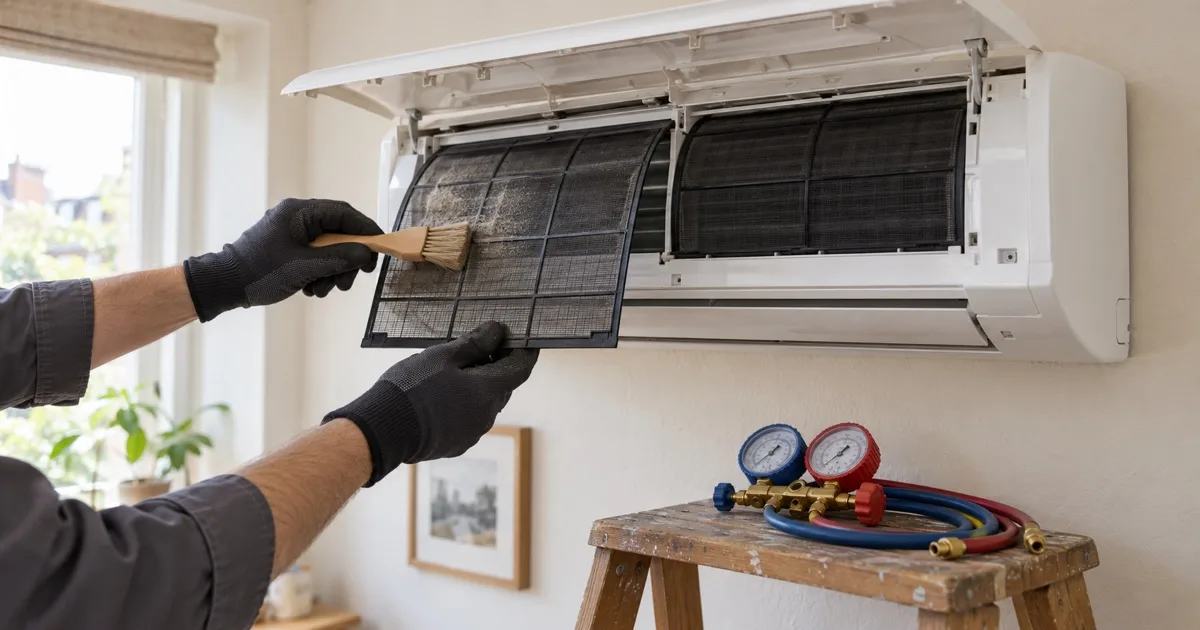
Most people's picture of an air conditioning service is somebody wiping a filter. The filter is the part you can do yourself, and we will show you how. The service is everything underneath it, and it is why a unit still runs at its rated output and smells of nothing after six summers.
Here is what happens, in the order we do it.
Inside the house
Filters. The front panel comes off and the mesh filters come out. They are washed and dried. On the units with a finer electrostatic or deodorising filter behind the mesh, that is cleaned or replaced to the manufacturer's schedule.
The coil. Behind the filters is the heat exchanger, a block of fine aluminium fins around copper tubes. In cooling mode it is wet for months and anything in the air that gets past the filters, dust, cooking grease, pollen, settles on it. A film on the fins cuts the unit's output and is where the musty smell starts. The coil is cleaned with a coil cleaner and rinsed into the tray, then treated with an antibacterial agent.
The fan. The long barrel fan behind the coil collects the same film, and a dirty fan is a noisier fan. It is cleaned in place.
The drain tray and drain. The tray under the coil catches the condensate; the drain carries it away. Both are cleaned, the drain is flushed through and its fall checked, and the pump, if there is one, is tested. Most "the unit is leaking" calls we take in July are a drain that was not flushed in May.
The run. The unit is run in every mode. We check the louvres move, the sensors respond, the display and the remote do what they should, and the air coming out is at the temperature the manufacturer's figures say it should be for the room.
Outside the house
The outdoor coil. The outdoor unit pulls air through a large coil at the back and sides, and over a year it collects leaves, seed fluff, cobwebs and street dust. A clogged outdoor coil makes the compressor work harder for less, and shortens its life. It is brushed and washed through, and bent fins are straightened.
The fan and the mounts. The fan is checked for balance and noise, the anti-vibration mounts for condition, the brackets or roof supports for tightness.
The electrics. Connections are checked and tightened; a loose terminal is the most common electrical fault on an outdoor unit and the easiest to prevent.
The refrigerant. This is the step that separates a service from a clean. The system's pressures and the temperatures across the coils are measured with gauges and compared with the manufacturer's figures for the conditions on the day. A system within its figures is left alone; a system outside them tells us something, usually a slow leak at a joint, which is found and fixed rather than masked by adding gas. "Topping up" a system every year is not a service, it is a leak nobody has looked for.
Why the manufacturers insist on it
Daikin, Mitsubishi Electric and Panasonic all make an annual service a condition of their guarantees, and after a few hundred services the reason is obvious: nearly every failure we see in a unit under ten years old traces back to a dirty coil, a blocked drain or a loose connection, all of which a service catches. Our installations include the first year's service for the same reason. It is the cheapest hour we spend on a system.
What to do between visits
One thing: the filters. Monthly in summer, lift the front panel, slide the mesh filters out, rinse them under the tap, let them dry, slide them back. It takes five minutes and keeps the coil cleaner until we see it. And on a cooling day, if you can, run the unit on fan-only for a few minutes before switching it off; it dries the coil and the tray, which is what the mould is waiting for.
When to book it
Spring, before the first hot week, for a system used mainly for cooling. Any time of year for one used for heating as well; the point is the interval, not the month. We remind you when it falls due, which is the other half of how a six-year guarantee gets to its sixth year.