
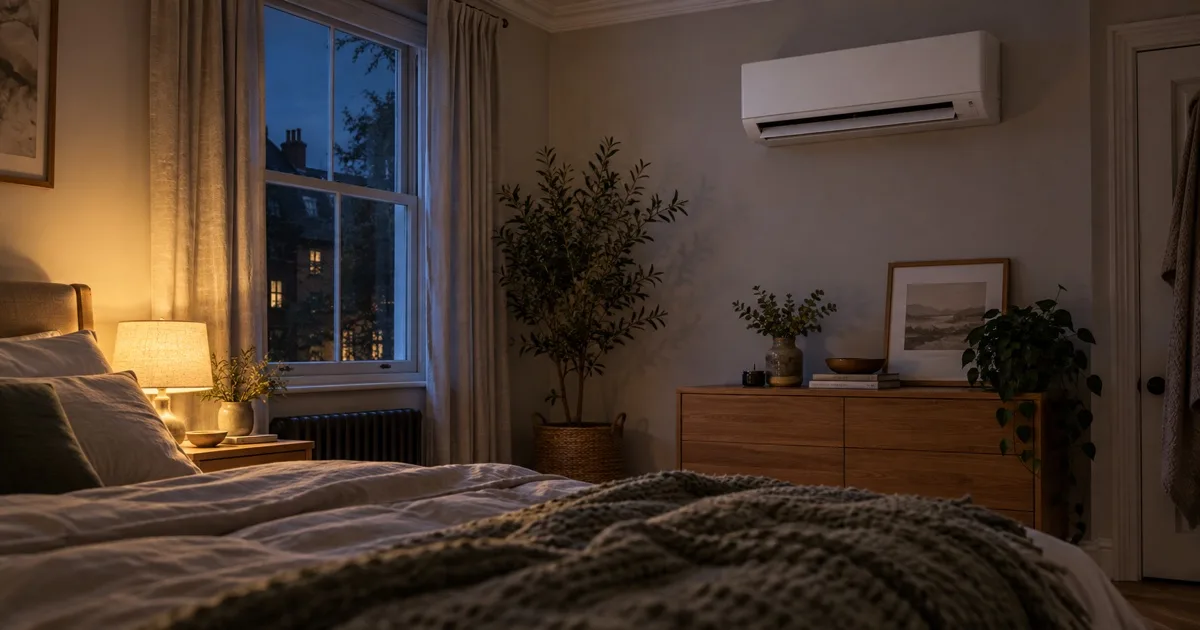
Last August one of our engineers stood in a loft bedroom in Streatham at eleven at night with the lights off, listening. The homeowner had asked the only question that mattered to her: "Will I hear it?" The unit on the wall was running on its lowest fan speed. What he could hear was the fridge downstairs.
That is the honest answer to "how quiet is quiet air conditioning": on the right setting, in the right place, quieter than the rest of your house. But the number on the brochure, 19 dB(A), needs translating before it means anything, and the number is only half of the story. The other half is where the two boxes go.
What 19 dB(A) actually sounds like
Manufacturers quote the sound pressure level of the indoor unit at its lowest fan speed, measured a metre away. For the quietest wall-mounted units from the three brands we fit, that figure is 19 dB(A): Mitsubishi Electric's Elegance range, Daikin's Perfera and Panasonic's Etherea all publish it. Panasonic's mid-range TZ units sit at 20 dB(A).
A decibel figure on its own is abstract, so here is the scale as a person hears it:
| Sound | Roughly |
|---|---|
| Leaves rustling, a quiet rural night | 20 dB(A) |
| A whisper at a metre | 30 dB(A) |
| A quiet library or a bedroom with the window shut | 35–40 dB(A) |
| A modern fridge running | 40 dB(A) |
| Normal conversation | 60 dB(A) |
Two things follow. First, 19 dB(A) is below the sound of your own bedroom at night; the World Health Organization's guideline for undisturbed sleep is an indoor level of 30 dB(A), and the unit on its quiet setting sits a long way under it. Second, the scale is logarithmic: 30 dB(A) is not "a bit louder" than 20, it is roughly twice as loud to the ear. That matters for the next point.
The setting is the catch
The 19 dB(A) figure is the lowest fan speed. Leave the unit on "auto" on a hot evening and it will run the fan harder to pull the room down to temperature, and at the top speed the same unit is in the mid-40s. That is still quieter than most bedroom fans, but it is not silent.
So this is how we set a bedroom unit up when we hand over, and what we tell every client:
- Cool the room before bed, on auto, with the door shut. Twenty minutes is usually enough for a bedroom.
- At bedtime, switch to the quiet or night mode. Every unit we fit has one; it pins the fan to its lowest speed and, on Mitsubishi Electric and Daikin, lets the set temperature drift up by a degree or two over the night so the compressor outside works less.
- Turn the display off. Panasonic and Mitsubishi Electric units have a button for it; a client of ours in Orpington put "nothing glowing at night" at the top of her list, and she was right to.
A unit run this way is, in our experience, something people stop noticing within a week.
Where the indoor unit goes matters more than which one
The quietest unit in the catalogue, hung on the wall above the bed head, will still be heard, because you are sleeping half a metre from the air outlet. On a survey we look for three things.
Not above the pillow. The unit wants to throw air across the room, not down onto the sleeper. The wall opposite the bed, or the wall beside the door, is nearly always better.
Something solid behind it. A wall-mounted unit on a stud partition will transmit the small vibrations of its fan into the plasterboard, which acts as a drum. On a solid brick wall, or a stud wall with the bracket screwed into the studs rather than the board, that disappears.
Room for the air to move. A unit crammed into an alcove or hard against a wardrobe has to work harder to circulate the air, which means a higher fan speed for the same result. Half a metre of clear wall either side is the rule of thumb.
The box outside is the one that wakes people up
Here is the part most guides skip. The indoor unit is rarely the problem. The complaints we have been called to look at, on installations other people did, were almost all about the outdoor unit.
An outdoor unit has a fan and a compressor, and a typical domestic one is rated around 46 to 50 dB(A) at a metre. That is the sound of a quiet conversation, and from inside a closed double-glazed window, ten metres away, it fades to very little. The trouble starts when it is fixed to the wrong thing.
A compressor vibrates. Bolt the unit straight onto a bedroom wall with a plain bracket and the vibration travels through the bracket into the brickwork, and the wall itself hums, faintly, all night. The same happens with a unit stood on a flat roof on a plank. The fix is mechanical and not expensive: anti-vibration mounts between the unit and whatever it sits on, which is why ours always go on rubber feet or damped brackets, and why on a flat roof we set them on proper supports rather than on the deck.
The second fix is placement. The fan throws its air out of the front of the unit, so the front should face away from the nearest window, yours or your neighbour's, and the unit should sit where a wall or a parapet stands between it and the bedroom. Behind the parapet of a flat roof is the quietest spot we know in a London terrace; a side return is the next best. All three brands also have a night-time quiet mode for the outdoor unit that trims the fan and compressor speed by a few decibels when you need it most.
What "quiet" should look like on your proposal
If a bedroom is the reason you are looking at air conditioning, these are the things we would expect to see written down before you agree to anything:
- The indoor unit's sound level at its lowest speed, from the manufacturer's data, not "very quiet".
- The position of the indoor unit on the wall, and why.
- Where the outdoor unit goes, what it sits on, and which way it faces.
- That the unit has a night mode and a display that switches off.
Ask for those four and you will sleep well in two senses.