
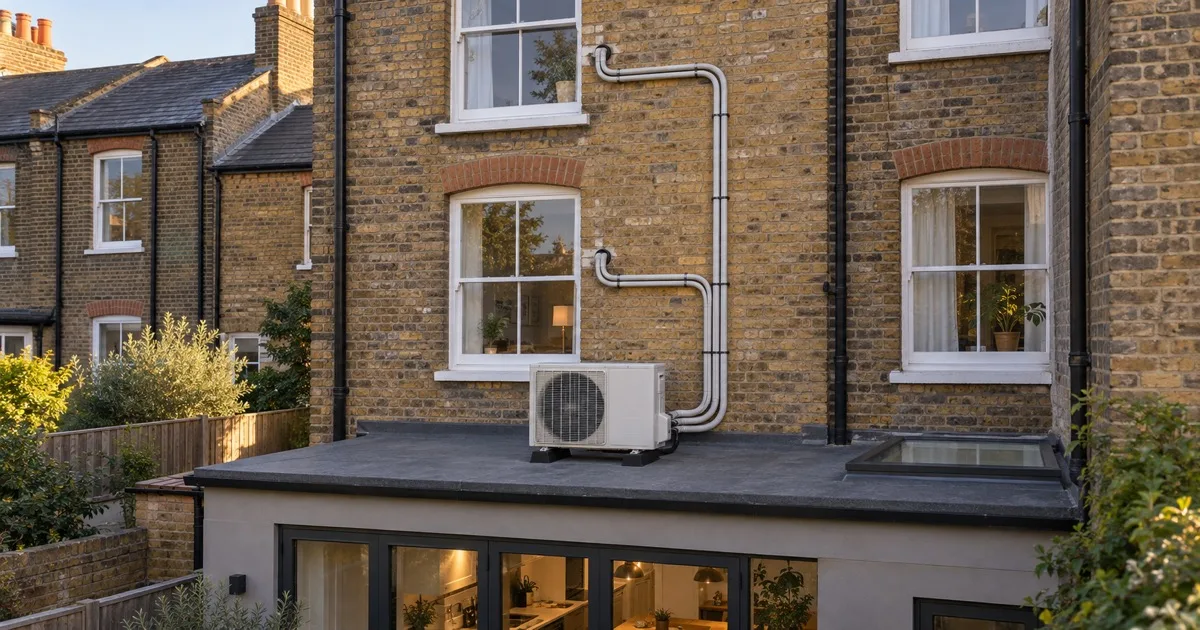
The question arrives on most surveys in the same words: "Can they all run off one box outside?" Usually they can. Whether they should is the more interesting question, and the answer depends on the house, the rooms and what you want them to do in January.
Two ways to build the same thing
A single split is the simplest system there is: one indoor unit, one outdoor unit, two pipes between them. Two rooms means two of everything, including two boxes outside.
A multi-split keeps the indoor units separate, one per room with its own remote, but runs them from a single outdoor unit. The domestic ranges from Daikin, Mitsubishi Electric and Panasonic carry two, three, four or five indoor units from one outdoor unit, each on its own pipe pair.
From inside the house the two look identical. The difference is entirely outside, and in one rule about how the system behaves.
Where the multi-split wins: outside
The outside of a London terrace does not have room for three outdoor units. It has a flat roof behind a parapet, or a side return, or one patch of rear wall that does not face a neighbour's bedroom. A multi-split puts one unit there, on one set of roof supports or one bracket, with one route for the pipework. Two or three singles would need two or three of each, and the pipework starts to wrap around the house in trunking.
So on a survey, once we know the rooms, the next question is where the one good spot for an outdoor unit is. If there is one good spot and two or three rooms, a multi-split is usually the answer. The outdoor unit is a little larger than a single's, but it is one box.
Where it loses: one mode for everyone
A multi-split's indoor units run in the same mode at the same time. They can be at different temperatures, and any of them can be switched off, but they cannot have one room heating while another cools. For most homes that is no limitation at all: on a July evening every room wants cooling, on a January morning every room wants heating. The exception is the house with a south-facing loft office and a north-facing bedroom in April, where one wants cool and the other warm; that pair wants two systems.
The second thing to know is that the outdoor unit is shared. If it stops, every room stops. Two singles fail separately. For a bedroom and a home office that is rarely a deciding factor, but we mention it, because it is the honest trade.
The combination table
The manufacturers publish, for each multi-split outdoor unit, the indoor units it may be connected to and a window for their combined capacity. The window is wider than the outdoor unit's own rating, because not every room runs flat out at once: a two-port Mitsubishi Electric unit rated at 4.2 kW accepts indoor units adding up to between 3 and 6 kW, and a three-port Panasonic unit rated at 6.8 kW takes between 4.5 and 11.2 kW of indoor units. Daikin's tables work the same way.
That window is what we design to. A living room at 3.5 kW and two bedrooms at 2.5 kW add up to 8.5 kW, which lands inside a three-port unit's range; add a fourth room and the sum moves to a four-port unit or, more often, a second outdoor unit near the rooms it serves. A design that sits outside the window is one the manufacturer will not warrant, which is why we check it on every proposal rather than trusting that bigger is enough.
When we fit two singles anyway
Three situations.
The rooms are far apart. A multi-split's pipework runs from each room to the one outdoor unit. A bedroom at the front and a kitchen at the back, with the outdoor unit on the rear extension roof, means a long run through the house for the bedroom. If there is a second sensible outdoor position near the front, two singles with short runs are tidier and work better.
The rooms want different things. The loft office and the north bedroom above.
The house is big. Past four or five rooms, one outdoor unit cannot carry the total inside its window, and the pipe runs get long. A recent nine-room house of ours became three outdoor units on the flat roof, each serving its own cluster of rooms. Still three boxes rather than nine.
What the proposal should say
If you are offered a multi-split, the proposal should name the outdoor unit, list the indoor units on it, and the sum should sit inside the manufacturer's window. If you are offered two singles for two rooms side by side, it is worth asking why; sometimes the answer is a good one, and sometimes it is that nobody checked the table.