
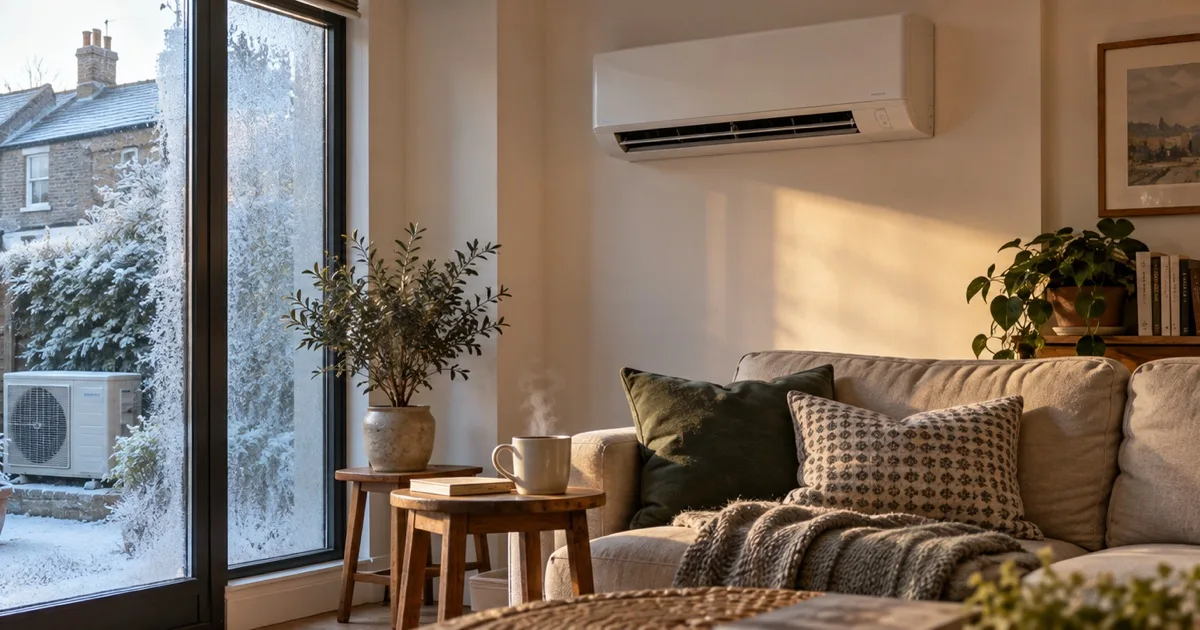
The question comes up on nearly every autumn survey, usually in the form "and does it do heat as well?", asked with the air of someone expecting the answer to be no, or to be a gimmick. The answer is yes, and it is not a gimmick: the heating is the same machine doing the same job in the other direction, and it does it with an efficiency no plug-in heater can approach. What follows is how it works and the two things worth knowing before you rely on it.
A fridge, pointed the other way
An air conditioner does not make cold; it moves heat. In summer the indoor unit's coil runs cold, the air in the room gives its heat to the refrigerant inside the coil, and the outdoor unit dumps that heat into the garden. A fridge does exactly this to its own interior.
In heating mode a valve in the outdoor unit swaps the roles. The outdoor coil runs cold, colder than the air outside, so the outside air gives up heat to the refrigerant; the compressor squeezes that refrigerant to raise its temperature; and the indoor coil, now the warm one, hands the heat to your room. Outside air at 2 °C still holds a great deal of heat, which is why this works on a January morning. The machine doing it is an air-to-air heat pump, which is the proper name for what sits on your wall.
Three or four for one
The reason this matters is the ratio. An electric heater turns one kilowatt of electricity into one kilowatt of heat, and cannot do better; that is simply what resistance heating is. A heat pump uses its kilowatt of electricity to move heat rather than to make it, and under typical British conditions it moves three to four kilowatts of heat for every kilowatt it draws. The manufacturers publish this as the coefficient of performance, the COP, and the seasonal version, the SCOP, averaged over a heating season.
In a room, that means the 3.5 kW unit on your living-room wall delivers its 3.5 kW of warmth while drawing around one kilowatt, roughly what a kettle draws, for as long as it runs.
It keeps working when it is cold
The ratio falls as the outside air gets colder, because there is less heat in it to collect and the compressor works harder. It does not fall to nothing. The units we fit from Daikin, Mitsubishi Electric and Panasonic are rated to keep heating at outdoor temperatures of −15 °C and below, which London does not reach; on the coldest mornings we actually get, around −3 °C, the output is down a little and the efficiency is still well above two to one.
This is why, when a room is going to rely on the unit for its heat, we size it a step up. A 2.5 kW unit that cools a bedroom comfortably in July will heat it on most winter days; a 3.5 kW unit will heat it on all of them.
The defrost pause
Here is the one thing that confuses people in their first winter. In cold, damp weather, and London in December is nothing else, frost forms on the outdoor coil, because that coil is running below freezing to pull heat out of the air. Left alone it would ice over. So every so often the unit runs a defrost cycle: it briefly reverses, sends a little warmth outside to melt the frost, and the indoor fan stops so that it does not blow cool air into the room. The outdoor unit may steam for a minute. Then the fan comes back and heating resumes.
The whole thing takes a few minutes and happens perhaps once an hour in the worst weather. It is normal, every heat pump does it, and the units are designed so that the room does not noticeably cool in the meantime. The first time, people think it has broken; after that, they do not notice.
What it heats, and what it does not
A split system heats the room its indoor unit is in. It does not heat the hall, the bathroom or the bedroom with the door shut, and it does not heat your water. In practice our clients use it in three ways. A home office warmed from cold in five minutes on a winter morning, without running the whole house's heating for one room. A living room kept comfortable through the shoulder months, October and April, when the boiler feels like too much. And a loft or an extension that the radiators never quite reached.
What it is not is a replacement for a boiler in a house with radiators in every room; for that you want the larger air-to-water heat pumps, which are a different installation. Think of the unit on your wall as the most efficient room heater you can own, which happens to also be the quietest way to cool that room in July.
Using it well
Two habits. Leave it running at a steady temperature rather than blasting it on and off; a heat pump is at its most efficient held at a setting, and the room stays even. And set the louvres to throw the warm air downward in winter, towards the floor, since warm air rises on its own and the point is to get it down to where you are. Both are a button on the remote, and both are things we set up and show you before we leave.