
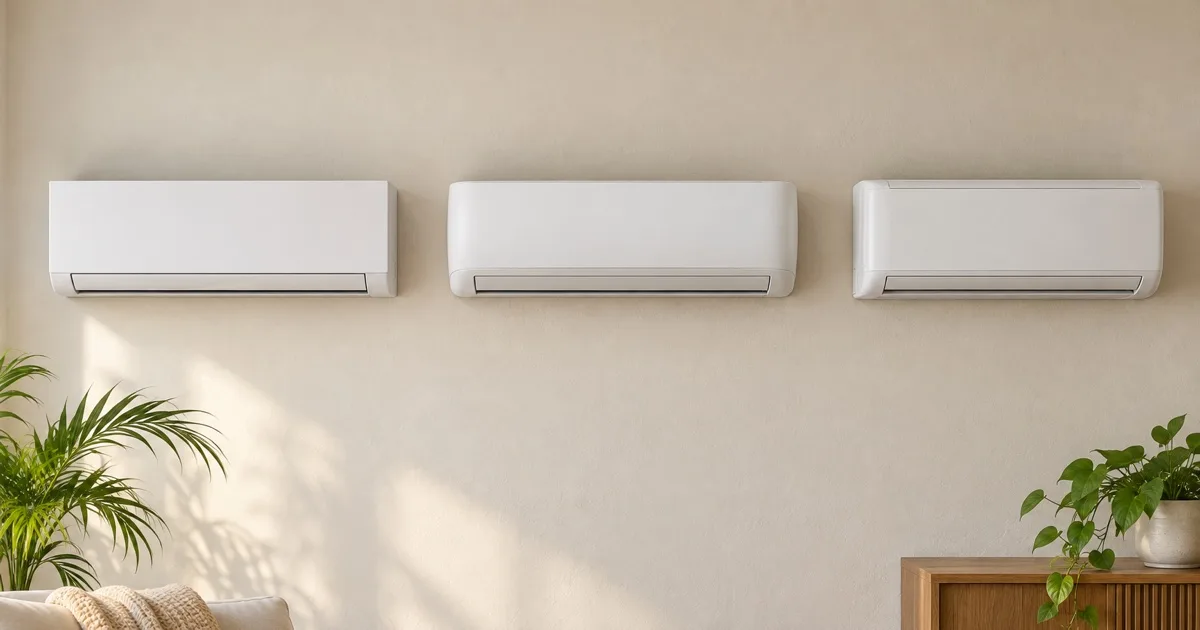
"Which brand is best?" is the question every client asks and the one we are least able to answer the way it is asked. We fit Daikin, Mitsubishi Electric and Panasonic, all three carry the same six-year guarantee through us, all three publish 19 dB(A) for their quietest wall units, and all three have been making reliable domestic systems for decades. The engineers' line, which is also the truth, is that they are all good and the difference is in the details under your room.
So here are the details.
Panasonic: the air itself
Panasonic's distinctive technology is nanoe X. A small generator in the indoor unit releases hydroxyl radicals, carried in water particles, into the air of the room while the unit runs. Panasonic's own testing, and independent laboratory tests it publishes, show these acting on odours, pollen, some bacteria and viruses, and mould spores on surfaces the air reaches. It is not a HEPA filter and does not replace one, but for a client with hay fever, a pet, or a room that has held a smell, it is a real difference and the reason we suggest Panasonic first in those conversations.
The ranges: TZ is the compact mid-range unit we fit most, quiet at 20 dB(A) and with nanoe X on board; Etherea is the premium unit, 19 dB(A), with a slimmer face, a switchable display and a more refined fan; BZ is the budget unit without nanoe X.
Mitsubishi Electric: the quiet one
Mitsubishi Electric's reputation is for the bedroom. Its Elegance mid-range wall unit publishes 19 dB(A) on its lowest setting, which puts it at the quiet end of what any manufacturer offers, and its premium Zen and Premium units add a sensor that reads the room's temperature across its width and steers the air away from people when they are in the airflow.
The less visible detail is the coil. Mitsubishi Electric coats the indoor unit's heat exchanger with a dual-barrier layer that resists dust and grease settling on it, which keeps the unit's output up between services and the smell down in a kitchen. Its outdoor units are also among the quieter ones, which matters on a wall shared with a neighbour.
The ranges: Classic at the budget end, Elegance in the middle, Zen and Premium above.
Daikin: the shape and the throw
Daikin's Stylish is the slimmest wall unit of the three, a flat face under 20 cm deep, in white, silver, black or a woodgrain finish, which is why it ends up in living rooms where the unit is on show. Its fan throws the air along the ceiling, the Coanda effect, so it reaches the far side of a room without blowing on anyone below, and its sensor reads the floor temperature to decide where to send it.
Daikin's Perfera is the quiet all-rounder at 19 dB(A) with a two-area sensor and a filter-and-streamer arrangement that treats the air passing through the unit. Comfora is the budget unit, and a very capable one; we fitted a pair recently to replace a 25-year-old Daikin system that had never missed a day.
The series matters as much as the brand
Every one of the three sells a budget unit, a mid-range unit and a premium one, and the differences between them run along the same lines: noise at the lowest setting, the sensors that steer the air, the quality of the fan and the finish of the case, and whether the air-treatment technology is included. A premium unit from one brand and a budget unit from another are further apart than two mid-range units from different brands.
So on a proposal the series is named, not just the brand, and it is chosen for the room: a loft bedroom for a light sleeper wants a premium unit for its 19 dB(A); a spare room used twice a month does not.
How we choose
Three questions, in order. What is the room for, and who sleeps in it. Is there an allergy, a pet or a smell to deal with. Is the unit on show in a room where its look matters. Those answers point at a brand and a series far more reliably than any ranking, and if two brands answer them equally well, we tell you so, because they are all good.